Heritage villas, bluestone and chasing cables without wrecking walls
A new circuit through North Adelaide bluestone or Unley sandstone is not a weekend groove. It is lime mortar, cornice plaster and a licensed electrician who isolates the board before anyone lifts a grinder.
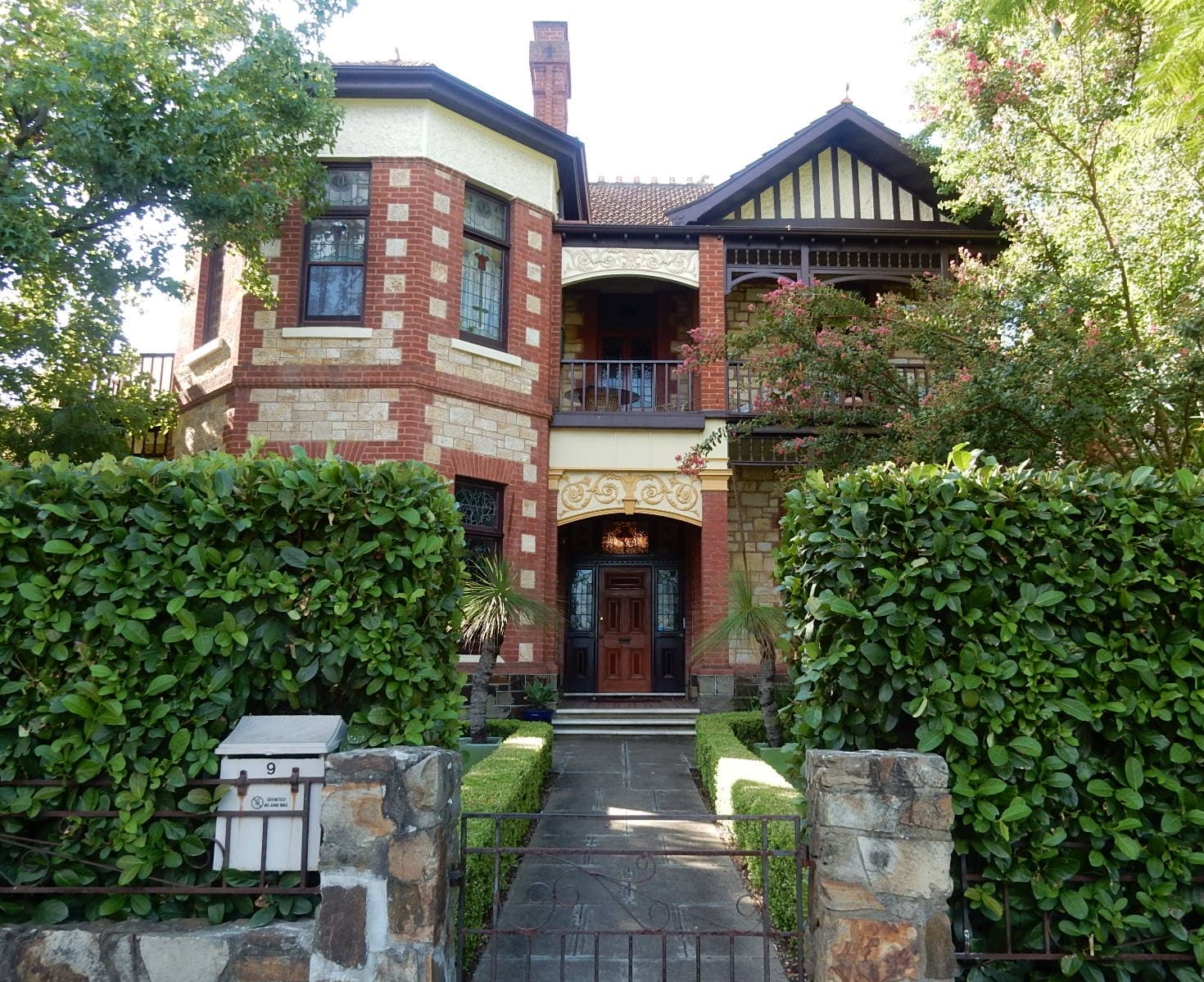
Photograph: Michael Coghlan. Licence: CC BY-SA 2.0. Source on Wikimedia Commons. Also listed on our image credits page.
The first thing a careful buyer notices in a North Adelaide villa is not the ceiling rose. It is the light on the stone. Bluestone turns afternoon shade into a cool, slightly damp grey. Sandstone through Unley and Norwood drinks the same light and looks warmer until you see the tool marks. Walkerville does a quieter version: deep verandahs, limewashed reveals, and walls that were never designed around thermoplastic sheathing. Those walls are why this journal treats Adelaide houses as a subject, not a backdrop.
A new kitchen, a heat pump, a study that has to carry two monitors — none of that is optional in a house people still live in. The question is how the copper gets from the switchboard to the room without turning a century of plaster into gravel. Done well, a chase disappears under a lime finish. Done badly, it is a trench that rings hollow, and a stone face that will never take the same colour again.
What chasing actually is
Chasing is not hunting a live cable through a wall with a drill and hope. That sentence sits at the top because the phrase travels badly. In the trade, a chase is a channel cut into plaster or masonry so a new cable can be buried and made good. It is planned, isolated and finished — not a fishing expedition behind a live powerpoint. If you can smell warm dust or the plate is discoloured, you are in the safety conversation, not the renovation one. Leave the circuit alone and ring a licensed electrician.
South Australia is unambiguous about the licence. Prescribed electrical work belongs to a person who holds one. When the work requires it, the finished job produces a Certificate of Compliance. Conveyancers ask for it. Insurers ask for it. A villa “tidied up” by a helpful brother-in-law with a multi-tool is a villa with a hole in its history.
A bluestone wall will forgive a small, well-sited chase. It will not forgive a groove cut on the diagonal because someone did not want to lift a floorboard.
The house, if you let it, will tell you where the voids already are. Many of these villas have a mean roof space and a generous subfloor. Skirtings are thick. Chimney breasts are thicker. Service cupboards often arrived with the first bathroom. A good electrician starts there, not with a grinder on the drawing-room wall.
Bluestone, sandstone, double brick
Bluestone in the inner suburbs is rarely a neat ashlar cube. It is rubble or roughly squared stone set in lime, sometimes with brick quoins, always with a plaster face patched by every decade since Federation. Lime mortar is softer than the stone: it moves a little, it breathes, it can be raked and replaced. A chase that cuts the plaster and then chews the mortar joints is not a cable path. It is a decision to loosen the face. Once the bond is gone, the plaster drums, and hairline cracks find the cornice.
Sandstone is kinder to a chisel and crueller to a stain. It cuts more readily, which is why people get ambitious with it, and it holds moisture and iron that bloom after a wet winter. A cement patch over a sandstone chase will read as a grey scar for the life of the house. If the work has to happen on a sandstone internal face — some Unley front rooms were finished in stone — the making-good has to be a lime or stone-dust mix, not a tub of modern base coat.
Double brick is the middle Adelaide story. Later villas and the better interwar houses in Norwood and Magill run two leaves with a cavity that looks, to anyone who has only wired brick veneer, like a gift. It is not always a gift. The cavity may be narrow, bridged by mortar, interrupted by a chimney, or already occupied by a pipe. Brick veneer, which takes over in the postwar streets and the Hills timber houses behind Stirling, is a timber frame, a cavity and a decorative leaf. Cable can travel in the frame if the electrician can reach it. Treating a veneer wall as if it were a North Adelaide solid is how you cut a brick that did not need cutting.
Hills timber — weatherboard and later fibreboard in Aldgate, Crafers and the wetter pockets above Blackwood — should almost never be chased as masonry. The voids are in the frame. The risk is a cable stapled against a damp nogging, or a penetration that lets weather into a wall that already works hard in winter. If your electrician talks about the house as one material, find another electrician.
The voids that already exist
I distrust the first proposal that involves the best room. Front parlours in North Adelaide and the long rooms facing the street in Unley were built to be seen. The plaster is thicker, the cornice is run lime, and the picture rail is often original. A new circuit for a television or a split-system head does not have to come through that wall. It can come up from the subfloor, across a hall cupboard, or down from the roof space in a corner that already has a later doorway.
Subfloors in the inner ring are often high enough to crawl, and often a museum of old gas pipe, early TPS and the odd porcelain remnant that should be treated as a warning, not as nostalgia. A licensed electrician will isolate and identify before anything is moved. You should not be in that space with a torch and a theory. These roofs were built for air, not for a forest of downlights. If the plan is a full rewire of a bungalow-era addition at the back of a villa, the addition and the old house need different tactics. The 1920s lean-to will take a ceiling void. The 1880s front will not.
Horizontal chases are the ones that come back as cracks. Gravity and plaster want a vertical path, close to a doorway, where a later trim can hide the make-good. A horizontal groove across the middle of a sandstone room is a line the house will remember. If that is the only way to a powerpoint, the honest answer is often surface work.
When the surface is the honest choice
Surface conduit has a bad reputation because the cheap version looks like a hospital corridor. The good version looks like joinery. Painted steel along a dado, a timber capping that matches the skirting, a run inside a built-in — these are not defeats. They are how you keep a lime cornice, and how you change the circuit later without opening the wall a second time.
In a heritage overlay the visible change may need a conversation with the council or a heritage adviser before anyone starts. That conversation is not the electrician’s licence and it is not a substitute for one. The overlay cares about the face of the stone, the verandah beam, the front fence, sometimes the chimneys. It does not waive AS/NZS 3000. A bathroom socket still sits where the standard says it sits. An outdoor point on a Glenelg or Henley Beach verandah still needs the right enclosure — the outdoor power and alfresco essay — and the same discipline.
A studio in the back garden makes the villa problem worse when the old house is treated as a spare way on the board and a chase through the breakfast room. A secondary dwelling is a load and a routing problem. It is not an excuse to trench the best wall because the trench looks shorter on a napkin.
What you ask before anyone cuts
Ask where the isolation will happen, and how they will prove the circuit dead. Ask whether the run can live in a void you already have. Ask what the make-good is — lime, stone dust, a plaster that can take the same paint — and who is doing it. Electricians are not always plasterers. The ones who work these streets usually have a finisher they trust.
Ask for the Certificate of Compliance when the work is prescribed. Ask to see the board labelled so the new circuit has a name that matches the room. If the board is still ceramic fuses in a laundry cupboard, the chase is the wrong first invoice. The board is.
None of this is an argument against modern circuits. These houses stay alive because people cook and sleep in them. They stay beautiful because the people who cut them treat stone and lime as materials with a grain. The licensed electrician who understands that grain will cost more than the quote that begins with a grinder. Pay the difference. The wall you do not wreck is the one you do not have to explain when the afternoon light hits the repair.
Questions readers send the desk
- Can I chase a cable myself if I isolate the circuit at the switchboard?
- No. Cutting a channel in masonry is the easy part to imagine and the expensive part to repair. Isolating, proving a circuit dead, opening a heritage wall and terminating a new run is prescribed electrical work in South Australia. A licensed electrician does it and issues a Certificate of Compliance when the work requires one.
- Is surface conduit always a defeat on a villa?
- Not if it is designed as joinery rather than as an apology. Painted metal or timber-capped trunking along a dado, or a discreet run in a service cupboard, often saves more original plaster than a hidden chase that later shows as a crack through a cornice.
- Do heritage overlays ban new powerpoints?
- Overlays protect fabric and appearance. They do not freeze a house in 1895. Councils and heritage advisers usually care about visible damage to stone, verandah posts and front rooms. Ask before grinding. The electrical rules still apply regardless of the overlay.