Outdoor power, pools and the Adelaide alfresco
Equipotential bonding, a socket that still closes after a hot January, and a spa that is not an appliance you discovered at the hardware store. The Adelaide backyard is a wet electrical environment that happens to have vines.
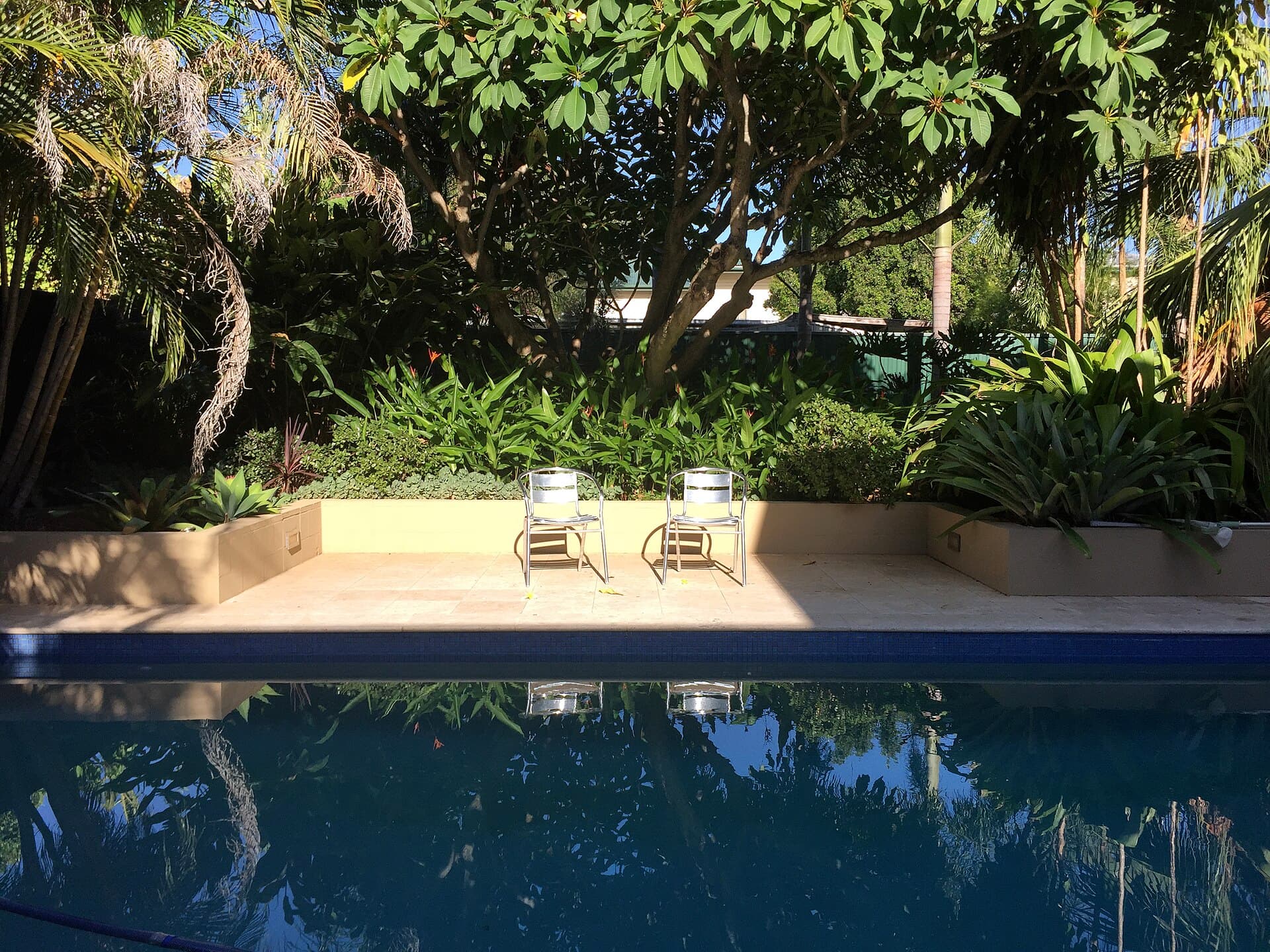
Photograph: Kgbo. Licence: CC BY-SA 4.0. Source on Wikimedia Commons. Also listed on our image credits page.
I earn my living in other people’s backyards, which in Adelaide means a room that is trying not to admit it is a room. The alfresco is a slab, a roof of some kind, a ceiling fan, and a string of decisions made after the furniture arrived. Norwood courtyards do it in brick and vines. Unley and Magill do it as a continuation of the kitchen. Glenelg and Henley Beach do it with salt on every screw. Stirling and Crafers do it under trees that drop litter into every fitting. Port Adelaide rusts a cheap enclosure before the warranty speech is over.
I am not here to talk you out of eating outside. I am here to say that water, bare feet and electricity are a designed relationship, not a vibe. Equipotential bonding, IP ratings, spa circuits and the heater you bought because July was rude — these are the parts of Adelaide houses that fail when the backyard is treated as an extension lead with aspirations.
Bonding, or why the water and the metal should agree
Equipotential bonding is a dull phrase for a simple idea. If you are in a pool, or on wet paving beside a spa, your body should not become the path between two bits of metal that are sitting at different voltages. Bonding ties the conductive parts together so they sit at the same potential. The wiring rules are specific about what is included around pools and spas. I am not going to fake a clause number in a housing journal. I will say this: if your pool builder and your electrician are not talking to each other about reinforcing, shell fittings, fences, equipment frames and the earth they share, you do not have a finished pool. You have a swimming hole with a future invoice.
I see this go wrong in two directions. The first is the older plains pool — a concrete shell from a decade when paperwork was thinner — now getting a new pump, a chlorinator and a heat pump on a pad that was never bonded to anything you can find. The second is the new granny flat backyard where a plunge pool arrived after the studio was signed off, and nobody wanted to open the ground again. Both are fixable. Both are licensed work. Both should produce a Certificate of Compliance you can show a buyer.
Heritage masonry does not exempt you. A sandstone terrace in North Adelaide or a bluestone Walkerville place with a later pool in the old stable yard still has to be bonded as a pool, not as a garden feature. The stone is the house. The water is the water.
If your feet are wet and the fence can carry a voltage, the fence is part of the electrical system whether you invited it or not.
IP ratings are not a personality
IP is a two-number way of saying how well an enclosure keeps out dust and water. The first number is solids. The second is water. A verandah socket that faces weather wants a rating and a cover that still closes after a summer of UV. A fitting over a pool wet area wants a conversation about zones, not a number you memorised from a catalogue because it sounded high.
I will not recite a zone map for your particular spa. The standard does that, and a licensed electrician applies it on site. What I will say, as someone who replaces these things, is that the failure is usually mechanical before it is theoretical. The cover chalks. The seal shrinks. The hinge remembers January. At Glenelg and Henley Beach the salt finds the spring. In the Hills the insects find the gap and pack it with nest. A rating on a box in a warehouse is not a rating on a western wall in February. Choose fittings for the climate in the summer piece, and then look at them every year as if they were part of the roof.
Double brick and brick veneer take different fixings. On a villa face I will surface-mount on stone before I cut it, and I will isolate and prove dead before I open a circuit that already exists. You should not be the person “chasing a cable” along a damp wall with the board still live. That is how people get hurt. If the circuit is suspect, it is a safety job, not a Saturday.
Pools and spas are equipment, not décor
A pool pump is a motor in a wet place with a chemical habit. It wants a dedicated circuit, residual current protection that suits the installation, and an isolator you can reach without standing in the overflow. A chlorinator and a heat pump are extra loads and extra enclosures. The pad they sit on should be the one the electrician and the pool technician both signed, not the one that was left after the landscaper won.
Spas are worse, because they arrive as a lifestyle object. The brochure shows steam and a glass of something. The nameplate shows a heating load that will embarrass a shared outdoor circuit. I have been called to Norwood courtyards where a spa was plugged into the same point as the outdoor fridge and the lights, and the owner wanted to know why the safety switch had no sense of occasion. The safety switch was the only adult on site. A spa needs a designed circuit, a look at bonding, and clearances that respect water and access. That is prescribed work. It ends with a certificate, not with a wider plug from a trailer.
Indoor–outdoor “swim spas” against a later addition are a special Adelaide habit. They sit half under a roof, half in weather, and they collect leaves along the cover. The electrical risk is the same as a spa plus the temptation to treat the under-roof half as indoor. It is not indoor. Design it as wet.
Festoon lighting, fans, the pretty loads
Festoon lighting is how a backyard tells itself it is finished. Low-voltage systems exist. So do cheap strings that are outdoor in the same way a straw hat is waterproof. Trees move. A cable stapled to a gum in Stirling or Aldgate is a cable with a future fault. If you want permanent festoon, support it as a permanent installation: strain relief, fittings that match the circuit, a protected supply, no daisy-chain through four sockets back to the kitchen.
Ceiling fans under an alfresco roof are a better habit, and they still want an enclosure and a mounting that will take a north wind. Heaters are the winter version of the same optimism. Electric radiant heaters are a real load. Gas heaters are a different tradesperson. The electrical mistake is hanging a high-current radiant bar on a lighting circuit because the space looked like a room. It is an outdoor area with a roof, and the circuit should have been drawn as one.
I like a well-built alfresco: a fan, two weatherproof double points on their own circuit, a light that is not a supermarket flood, and nothing hanging from a tree that I will be asked to find in the dark. That package is the one I can certify.
Heat, salt, embers, the same backyard
Adelaide does not give you one outdoor climate. The western beaches cook fittings and salt them. The inner plains cook them without the salt. The Hills add litter, damp winters and, on the right lots, ember attack around external boards and inlets. A generator inlet on a Crafers or Blackwood verandah is outdoor power. Siting and sealing belong in the same sentence.
If you are adding outdoor circuits as part of a broader summer upgrade, treat the board as the project. Residual current protection that does not cover the backyard is not protection. Labels that still say “verandah” when the verandah is now a kitchen are how the next electrician wastes an hour you will pay for.
I isolate before I remove a cover. I test before I touch a conductor. I do not tell homeowners to hunt a live cable through wet paving, and I will not write that instruction here. If a fitting is warm, if a plate is discoloured, if a trip happens only when the spa cover is off, stop using that circuit and call someone licensed. If there is smoke or flame, that someone is 000 first.
The Certificate of Compliance is the last page of a backyard job that included new points, a spa circuit, bonding, or a board change. Keep it with the pool paperwork. The next owner of a Glenelg masonry or a Magill brick veneer will not thank you for the vines. They will thank you for a backyard that was designed as the wet room it always was.
Questions readers send the desk
- Does every Adelaide pool need equipotential bonding?
- Conductive parts in and around a pool are a bonding conversation under the wiring rules. Whether your particular shell, reinforcing, fence and equipment need a new bond is a site decision for a licensed electrician, not a yes from a suburb name. If the pool is new or the equipment is being replaced, ask to see the bonding on the drawing and on the Certificate of Compliance.
- Is festoon lighting on a tree acceptable if it is sold as outdoor?
- Outdoor on the box is not a design. Trees move, insulation perishes, and a socket on a verandah is often already carrying a fridge. Use fittings and support that suit a permanent installation, on a protected circuit, installed by a licensed electrician. Temporary party lighting is for a party, then it comes down.
- Can I add a spa to an existing outdoor circuit?
- Unlikely to be the right answer. Spas are a heating and pump load with water attached. They want their own designed circuit, the right residual current protection, and a look at bonding and clearances. That is prescribed work, not a wider plug.