Hot water, heat pumps and the electrical load they hide
The cylinder in the cupboard does not have a screen, which is why people forget it is one of the largest electrical decisions in the house. Off-peak, inrush and solar-sponge thinking only work if the board can host the current.
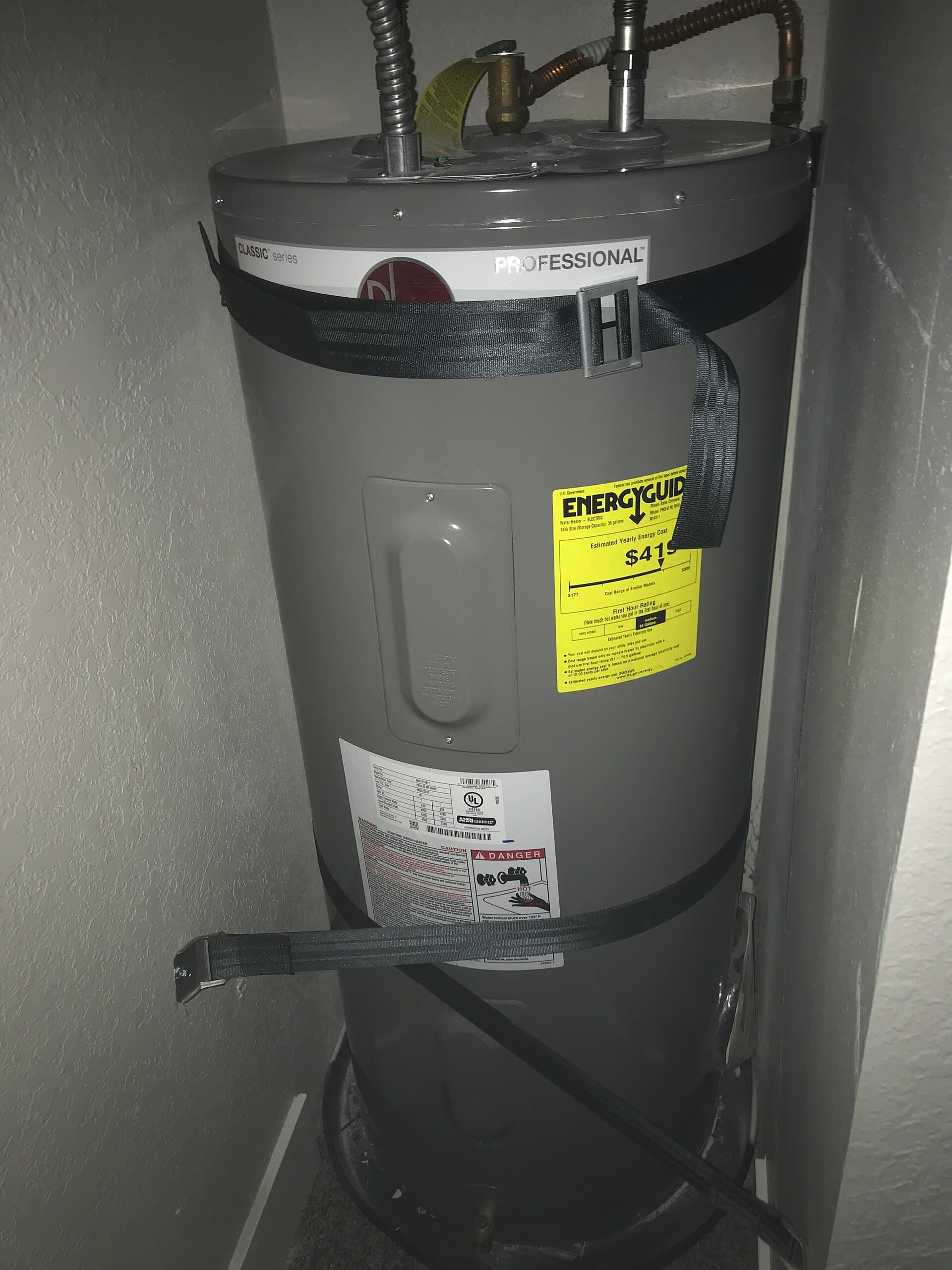
Photograph: Steven Pavlov. Licence: CC BY-SA 4.0. Source on Wikimedia Commons. Also listed on our image credits page.
The photograph that stands in for domestic hot water is almost always the same: a white cylinder in a service cupboard, lagged, labelled, slightly too large for the door that closes on it. The image on this page is that object — a storage heater of the family you have walked past for twenty years without thinking of it as electrical plant. Storage systems look inert. They are not. They are one of the largest regular loads in an Adelaide house, and they are the load people forget when they add solar, a charger and a cooktop and then declare the board “basically fine”.
This is the unglamorous essay in the energy set. It has no app worth mentioning and no rebate conversation this desk will invent figures for. It has a circuit, a tariff habit, a starting current, and a cupboard. If you have been told a heat pump will “just sit on the existing circuit”, read to the end before anyone orders a tank.
The cylinder in the cupboard
Resistive storage is simple. A large element heats a volume of water, a thermostat calls, and the board sees a chunky, predictable load. In South Australia that load often arrived on a controlled-load or off-peak circuit: a second meter register, a relay, a night-time window when the city had energy it wanted to put somewhere. Many of those cylinders are still in Pooraka laundries and Glenelg side yards, working, unlabelled, on a relay nobody has tested since the last tenant.
Instantaneous electric asks for a great deal of current at the tap. Some later houses have it. Many bungalows do not have the service for it. When a gas unit dies, the replacement is often framed as a heat pump or a large electric cylinder, and that framing hides a board question. Heat-pump water heaters move heat from air into water. They use less energy over a day than a resistive cylinder on the same duty, which is why they are spoken of as if they were electrically small. They are not small at start-up. They are a compressor. They want a circuit, a location that suits noise and condensate, and air that is not a sealed cupboard in February. The marketing photograph is a tidy tank. The installation is a refrigeration appliance bolted to a plumbing job.
Northern suburbs rooftops already make a lot of daytime electricity. A cylinder that only ever heats at 1am is, on those roofs, a missed conversation. A cylinder that can heat at 11am is a useful sink — if anyone has given it permission to wake when the inverter is exporting.
Off-peak, controlled load and habit
Off-peak hot water is a habit wearing a tariff’s clothes. If your meter still has a controlled-load register, and your retailer still prices it, the night window may still be the cheapest way to run a resistive cylinder. It may also be a leftover from a city that now has a surplus at noon. Solar-sponge and time-of-use products exist because of that shape. They change. This desk will not treat any of them as permanent, and will not attach a dollar figure to them.
The practical question is whether the cylinder is still on a relay that only closes in the small hours, and whether that is still what you want. A heat pump that cannot run until 1am on a 7-degree Aldgate night is being asked to work in its worst air. A resistive cylinder that cannot run at midday on a Mawson Lakes roof is being asked to ignore the cheapest electrons the house produces. Ask the retailer what registers you have. Ask the electrician whether the controlled-load circuit is still a clean run, or a historical arrangement that has grown a shed light. A Certificate of Compliance for a new water-heater circuit should say what the circuit is. If you are coming off gas, you are adding a large load that was previously a pipe. The switchboards hub is the prior reading. A fuse board that has never seen this current should not see it on a Friday afternoon.
Heat pumps and the current they ask for
A heat pump’s daily energy use can look modest on a brochure. Its starting current does not live there. Compressors draw a short, rude gulp. On a long suburban run, or on a board that already hosts an inverter and a ducted plant, that gulp is a flicker, a tripped breaker, or a voltage dip the lights remember. Soft starters and inverter-driven compressors exist. They are not universal. Ask which architecture is being supplied.
Hot water is the load people forget because it does not have a screen. It still arrives on the same copper as the charger and the inverter.
Location is electrical as well as acoustic. A unit against a bedroom wall in Blackwood will become a neighbour dispute. A unit in a sealed cupboard will overheat. A unit on a gulf-side wall in Marino will corrode if the specification assumed a polite inland courtyard. Clearances in the manual are not suggestions. Condensate needs somewhere to go that is not the meter box. Many heat-pump heaters want a dedicated circuit, their own isolation, and residual-current protection that matches the appliance. They do not want a lead into an outlet that “has always been there”. A licensed electrician will say no to that outlet. If the house already has an EV charger in the garage, introduce the two loads on paper before they meet at 6:30pm. A heat pump that starts a defrost at the same moment as a cooktop and a charger is how a “fine” board becomes a story.
Solar sponge thinking
Adelaide learned early that midday electricity can be abundant to the point of inconvenience. Export limits from SA Power Networks, and inverters that sit down when voltage rises, are ordinary facts on northern suburbs rooftops. A water heater that can take surplus is one of the few household loads large enough to matter. That is the charitable reading of “solar sponge”: not a slogan, a sink.
The uncharitable reading is a timer set to 10am on a cylinder that cannot finish a heat before the school run, or a smart relay that depends on Wi-Fi in a laundry that has none. Controls should fail toward a full tank. If the sun does not appear — a July week in Stirling — the household still needs hot water. Pairing a sponge with rooftop solar and a well-set inverter is the right order. The inverter’s export behaviour and the cylinder’s recovery time belong on the same sketch. Use the cheap thermal store first if the tank is being replaced anyway. Do not buy a smaller tank because “solar pairing” will not survive two teenage showers. Aldgate and Stirling do not have Mawson Lakes’ open sky. Size the store for the week you actually live, then let the sun cheapen the good days.
Board capacity when everything arrives at once
A house that adds a heat pump, a charger and a cooktop in the same three years is restating the service. The main switch, the incoming cable, the spare ways and the neutrals are the design. If the board is still a fuse board, the water heater is not the conversation. Upgrading from fuses to residual current devices is. Isolation has to remain reachable after the tank is in. A switch behind a cylinder is a future invoice.
SA Power Networks enters when the service itself must change — a larger connection, three-phase, a meter reconfiguration beyond a retailer setting. A household electrifying everything at once often needs that conversation. Do not let a plumber’s quote become a connection application by accident. A licensed electrician isolates, tests and leaves a Certificate of Compliance. The plumber’s sheet is not that paper. Incentives for heat pumps come and go, as the Home Battery Scheme did in its own lane. Treat any current offer as a date and a government page. Design the circuit for the house that remains when the offer has closed. The cupboard will still be there. The current will still be there. The only question is whether anyone looked at both before the tank was ordered.
Questions readers send the desk
- Is a heat-pump water heater a small load because it uses less energy?
- It uses less energy over a day than a simple resistive cylinder on the same duty, which is why people buy it. The electrical service still has to host starting current, a dedicated circuit and whatever else is already on the board. Cheap to run is not the same as small to connect.
- Should I keep hot water on a controlled-load or off-peak circuit?
- Only if that tariff and that control still exist on your meter and still match how the household uses water. Many Adelaide houses inherited an off-peak cylinder and never revisited it after solar arrived. A heat pump or a solar-sponge schedule may want a different circuit and a different clock. Ask the retailer what you actually have, then ask the electrician what the board can do with it.
- Can the existing switchboard take a heat pump if it already has solar and a charger?
- Sometimes. The only honest answer is a look at spare ways, the main switch, the residual-current arrangement and the service capacity. If the board is a fuse board, or already full, the water heater is not the first job. The board is.