Three-phase power in suburban Adelaide: when you actually need it
Three-phase is not a status symbol. It is a network conversation about workshops, induction cooktops, ducted air and the moment an EV charger arrives on a board that already hosts solar. Sometimes load management is cheaper than a new service.
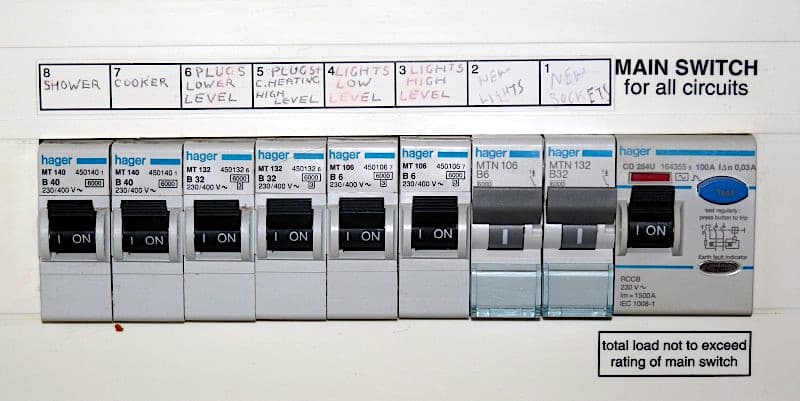
Photograph: Pfnicholls. Licence: CC BY-SA 4.0. Source on Wikimedia Commons. Also listed on our image credits page.
Three-phase turns up in suburban Adelaide more often than the street suggests. The bungalows of Unley and the villas of Norwood look like single-phase houses, and most of them are. Then someone opens a meter box in a western-suburbs cavity-brick place that used to be near a workshop, or a 1960s brick veneer in Campbelltown whose previous owner ran a cabinet shop in the garage, or a Hills timber house in Stirling with a ducted system, a spa and a kiln, and the board has three incoming lives where the neighbour has one.
The question is not whether three-phase is modern. It is whether the load you actually have needs it, and whether the cheaper answer is to stop asking every appliance to run at four o’clock on a February afternoon.
What three-phase is doing in a house
In the ordinary suburban arrangement, one active conductor and a neutral give you about 230 volts. Three-phase brings three actives, spaced so that a motor can be happier, a large cooktop can split its load, and the incoming capacity can be higher without asking a single conductor to carry the whole of a workshop. Between phases the voltage is higher. That fact alone is a reason to leave the lid alone. Nobody on this desk will tell you to work live on a single-phase board. A three-phase enclosure is not the place to invent an exception.
The rest of the Australian rules still apply. The MEN link at the main switchboard still bonds earth and neutral. AS/NZS 3000 still expects the installation to be designed, protected and tested. Residual current protection — RCD or RCBO — still belongs on the final subcircuits people touch, on each relevant phase, not as a single souvenir device at the top of a crowded tray. A three-phase board that is all miniature circuit breakers and no residual current protection is not an upgrade. It is a larger version of the 1960s problem.
A licensed electrician will treat the incoming arrangement, the main switches, the earth bar and the labels as one job. You should see a Certificate of Compliance when prescribed work is finished. SA Power Networks will have its own paper if the service itself changed. Keep both.
The loads that actually start the conversation
Workshops come first, historically. A welder, a compressor, a saw that was never meant to live on a 15-amp socket — those are why three-phase appeared in otherwise quiet streets of Torrensville, Hindmarsh and the industrial edges of Bowden. The house in front may still be a cavity-brick bungalow. The garage is the reason the meter looks different. If you have just bought that house and you do not have a workshop, you may not need to keep the arrangement. You do need to understand it before someone “simplifies” the board into a mess.
Cooktops come next in the present decade. A large induction surface can be fed single-phase if the circuit and the diversity of the house allow it. Some want more. The brochure will say so in a font that assumes the street already agrees. The street has not agreed until SA Power Networks and a licensed electrician have looked at the service, the board and the other loads. A Norwood villa with a new kitchen and an old fuse tray is not waiting for three-phase. It is waiting for a board that has reached its use-by to be replaced on the supply it already has.
The contemporary pile-up is rooftop solar, a battery conversation, a ducted reverse-cycle system, and an EV charger in a carport designed for a single Falcon. Each item can be reasonable. Together, on a late afternoon, they ask the service for a coincidence. Three-phase is one answer. Load management is another: a smaller charger, a staggered hot-water window, a ducted system that does not share its worst moment with the oven.
Hills timber houses complicate the pile-up with longer runs and a climate that makes ducted air less optional. 1960s brick veneers on the plains often have the opposite problem: a thin board, and an owner who has been told that three-phase is how you “future-proof”. Future-proofing should be made to sit down and name the loads.
Three-phase is a conversation with the network, not a sticker on the meter. If the load can be timed, staggered or limited, the conversation may not be necessary.
SAPN, the street, and the cost that is not the cooktop
SA Power Networks owns the poles and the service cable. A new three-phase connection is not a product a kitchen studio can add at the checkout. It is an application, an assessment of the local network, possible work at the pole or the pit, a meter change, and then an installation on your side that a licensed electrician designs to AS/NZS 3000. The costs split in ways owners dislike: network charges that are not a quote for a board, and board charges that are not a quote for the street. Budget for both.
Sometimes the network cannot give you what the brochure wants, or cannot give it without a contribution that makes the cooktop look cheap. Inner-suburban streets with older assets — Unley, Prospect, the tighter villas around Kent Town — are not empty canvases. Western suburbs with a more industrial past can be easier.
A service upgrade that leaves the indoor board as a ceramic tray is a wasted truck. The MEN link, the main switches, the RCBO ways, the solar and charger isolators, the labels — those are the house half. The switchboards and wiring hub is the map of that half. If the wiring behind the board is the original TPS in a western cavity, or the mixed-age runs of a bungalow, read rewiring a 1950s Adelaide bungalow before you assume the new service will land on a healthy installation. Capacity at the street does not repair a joint in the roof.
Load management before a new phase
The unglamorous work is a load schedule. An EV charger can be set to a current the board can host. A hot-water system can be moved off the coincident peak. A ducted system can be a dedicated circuit that does not share its worst hour with the oven and the charger. That requires a licensed electrician who is willing to design instead of upsell.
Solar complicates the folklore. Export is not the same as running the house when the street is quiet. An inverter on a single-phase service is still the Adelaide default. Three-phase inverters make sense when the service is already three-phase, or when the loads justify the extra hardware. They do not, by themselves, require you to upgrade a modest bungalow because a neighbour in Mawson Lakes has one.
Neutral faults remain relevant. A three-phase installation with a damaged neutral is a more energetic way to rearrange voltages. The MEN system still has to be intact. If lamps have been glowing or metalwork tingling on the old single-phase board, fix that before you ask the network for more. Neutral faults in older SA homes is the essay for that fault. Adding phases on top of a floating return path is how a workshop becomes a case study.
When you do actually need it
You need it when the design says you need it. A workshop motor that is three-phase by nature. A cooktop whose manufacturer’s instructions, read by a licensed electrician rather than a salesperson, require a three-phase circuit the existing service cannot host. A coincidence of EV charging, ducted air and cooking that cannot be managed without leaving the house short. A commercial-style load on a suburban title that was never going to sit on one active. Those are reasons. “Someone told me it adds value” is not a reason. “The listing said off-grid ready” is not a reason.
The licensing and standards hub is the civic neighbour: who may apply, what a Certificate of Compliance is, why an owner-builder is still not a distribution business. Have the load named. Have the board read. Have SA Power Networks asked before the kitchen is ordered. Expect residual current protection on the new circuits, a MEN arrangement that is still a MEN arrangement, and labels that mention phases without looking like a riddle.
If the answer is no, the house is still allowed to cook dinner — on a smaller cooktop, or on a charger that takes the overnight hours seriously. Suburban Adelaide has lived on single-phase for a century of bungalows, villas, veneers and cavity brick. Three-phase is a tool. It is a good one when the load is real. It is an expensive way to avoid a conversation about what the house is being asked to do at once.
Questions readers send the desk
- Does an EV charger mean I must have three-phase?
- No. Many suburban chargers run on a single-phase circuit if the board and the service have the capacity, or if the charger is limited. Three-phase becomes a conversation when the charger, the ducted system, the cooktop and the solar export are all asking the same afternoon for more than the service can give.
- Who do I talk to about a new three-phase connection?
- A licensed electrician first, then SA Power Networks through the connection process that electrician will know. The network owns the street. The Certificate of Compliance covers the installation on your side. Do not start with a cooktop brochure and work backwards.
- Is three-phase more dangerous than single-phase?
- It is a different arrangement with higher voltage between phases. It still uses the MEN system, still expects residual current protection on the circuits people touch, and still belongs to a licensed electrician. It is not a reason to work live, and it is not a toy for a workshop that has not been designed.